Research Paper

Discussion: Reading Comprehension: Strategies and Activities

When teaching students to comprehend and summarize text, teachers can use a variety of activities before, during, and after reading to help students understand elements within a plot. Utilizing appropriate strategies that incorporate summarizing skills helps to increase students’ reading comprehension skills. Discussion: Reading Comprehension: Strategies and Activities

Use the “Reading Comprehension Template” to complete this assignment.

Part 1: Strategies

Research and summarize, in 250‐500 words, a minimum of five strategies for teaching adolescent students with deficits in their reading comprehension skills. Identify the conditions under which the chosen strategies are intended to be delivered (e.g., content area, class setting, required resources, if intended for a specific type of disability).

Support your findings with 2‐3 scholarly resources.

Part 2: Activity

Identify a group of 2‐3 eighth grade students, using the “Class Profile,” who would benefit from additional instruction on reading comprehension skills.

Identify a text appropriate to use with the small group identified. You may use Appendix B of the Common Core English Language Arts Standards to help you determine an appropriate text for the lesson.

Draft a 250‐500 word outline summarizing three activities to reinforce reading comprehension and summarizing skills, utilizing the identified text. Incorporate at least three of the strategies from Part 1 into your activities.

Part 3: Rationale

In 250‐500 words, rationalize your instructional decisions in Part 2 of this assignment. Explain how the identified strategies and activities enhance the language development of adolescents with deficits in their reading comprehension skills. Cite the “Class Profile” where appropriate.

2attachments

Slide 1 of 2

  • open in full 24px minwordattachment_1attachment_1open in full 24px minthumb 20190416222457spd 560 class profile page 0
  • open in full 24px minwordattachment_2attachment_2open in full 24px min

Class Profile

Student NameEnglish Language LearnerGenderOtherAgeOral Language DevelopmentUses Phonics and Morphology to Decode WordsReading Lexile/GradePerformance LevelWritten Expression LevelSocial/Pragmatic/Communication Skills
ArturoYesMaleTier 2 RTI for readingGrade level Below grade level  NoBelow grade level Below grade level Good
BertieNoFemaleNoneGrade level Above grade level YesAbove grade levelBelow grade level-writing simple sentencesNeeds help resolving conflicts
BerylNoFemaleNOTE: School does not have gifted programGrade level Above grade level YesAbove grade levelAbove grade level  Good
BrandieNoFemaleTier 2 RTI for mathGrade level Below grade level No; reads sight words onlyBelow grade levelBelow grade level-only writes name and sight wordsNeeds help with verbal and nonverbal signals
DessieNoFemaleTier 2 RTI for mathGrade level At grade level YesAt grade level Below grade level Good
DianaYesFemaleTier 2 RTI for readingGrade levelBelow grade levelNo Below grade levelBelow grade levelGood
DonnieNoFemaleHearing aids Grade level Below grade level NoAt grade level Above grade level  Good
EduardoYesMaleTier 2 RTI for readingGrade level At grade level YesBelow grade levelBelow grade level-writing simple sentences Good
EmmaNoFemaleNone Grade level Above grade level YesAt grade level Above grade level  Good
EnriqueNoMaleTier 2 RTI for reading One year above grade level At grade level No; reads sight words only Below grade level Below grade level Good
FatmaYesFemaleTier 2 RTI for readingGrade level  At grade level  Yes Below grade level Below grade level-only writes name and sight words  Needs help rephrasing when misunderstood
FrancesNoFemaleDiabetic Grade level At grade level Yes At grade level At grade level Good
FrancescaNoFemaleNoneGrade level Above grade level Yes At grade level Above grade level Needs help staying on topic
FredrickNoMaleTier 3 RTI for reading and mathOne year above grade level Below grade level No; reads sight words onlyBelow grade level Below grade level-writing simple sentences Needs help with verbal and nonverbal signals
InesNoFemaleTier 2 RTI for mathGrade level Above grade level Yes Below grade level At grade level Good
JadeNoFemaleNoneGrade level At grade level Yes At grade level Below grade level Good
KentNoMaleNoneGrade level Above grade level Yes At grade level Above grade level Good
LolitaNoFemaleNoneGrade level Below grade level Yes At grade level At grade level Good
MariaNoFemaleNOTE: School does not have gifted programGrade level Above grade level YesAt grade level Above grade level Good
MasonNoMaleNoneGrade level  At grade level  YesAt grade level  At grade level Needs help staying on topic
NickNoMaleNOTE: School does not have gifted programGrade level Above grade level YesAbove grade level Above grade level Needs help taking turns in conversation
NoahNoMaleNoneGrade level At grade level Yes At grade level At great level Good
SharleneNoFemaleNoneGrade levelBelow grade level No; reads sight words onlyAbove grade level At great level Good
SophiaNoFemaleNoneGrade level Above grade level YesAt grade level At grade level Good
StuartNoMaleAllergic to peanutsGrade level At grade level YesAbove grade levAt grade level el At grade level Good
TerrenceNoMaleNoneGrade level At grade level YesAt grade level Below grade levelNeeds help resolving conflicts
WadeNoMaleNoneGrade level Below grade level YesAt grade levelAt grade level Good
WayneNoMaleTier 3 RTI for mathGrade level Below grade level  YesBelow grade levelAt grade levelNeeds help rephrasing when misunderstood
WendellNoMaleTier 3 RTI for mathGrade level At grade levelYesBelow grade level Below grade level Good
YungNoMaleNOTE: School does not have gifted programOne year below grade level At grade level YesAbove grade level Below grade level Goo
Read More
Research Paper

Instructional Models Strategies Worksheet

Instructional models apply learning theories to the selection of instructional strategies in a manner that will improve planning and differentiation to aid in student success. Understanding how various teaching models and strategies were designed to better reach students allows teachers to adjust their teaching styles to adapt their classrooms.

For this assignment, complete the “Instructional Models/Strategies” template .

Part 1: Analysis

  • Describe the defining characteristics of each instructional model or strategy.
  • Include an example of how you would use the instructional model or strategy in your teaching to meet the needs of diverse students.
  • Explain how the instructional model or strategy supports the diverse needs of students.

Part 2: Application

Review the academic standard and learning objective you created in Topic 2. Using the “Class Profile,” select three of the six instructional models from Part 1 that would be appropriate to teach the standard and objective.

For each model, include the following:

  • Explanation of how you would implement the model or strategy to teach the standard and objective from Topic 2
  • Rationale explaining why the instructional model or strategy is effective in supporting student learning of the standard and objective

Support your findings with 2-3 scholarly resources.

APA style is not required, but solid academic writing is expected.

Resources

TOPIC: In Georgia the standard are called Georgia Standards of Excellence (GSE) and they can be found at org/Georgia-Standards” target=”_blank” rel=”noreferrer noopener”>https://www.georgiastandards.org/Georgia-Standards . The grade level in which I am currently interested in is Kindergarten, Math. For the standard in which I am considering is K.CC which covers counting and cardinality. Students must first understand counting and understand the relationship between numbers to have a strong foundation. Focus on K.CC.A.1

Review Chapters 3, 4, 5, 8, and 10 for models discussed in the assignment template.

URL:

http://www.gcumedia.com/digital-resources/pearson/2015/instruction_a-models-approach_7e.php

Read “10 Evidence-Based Teaching Strategies” by Pakizer located on the Simple K12 website (2016).

URL:

Read “Teaching Tools and Strategies for Diverse Learners” by O’Donnel located on the International Literacy Association website (2016).

URL:

https://www.literacyworldwide.org/blog/literacy-daily/2017/10/26/teaching-tools-and-strategies-for-diverse-learners

2attachments

Slide 1 of 2

  • open in full 24px minwordattachment_1attachment_1open in full 24px minthumb 20201217155738sample template page 0
  • open in full 24px minwordattachment_2attachment_2open in full 24px min

Instructional Models/Strategies

Part 1: Analysis

  Description Example Supporting DiverseNeeds of Students (ie. ELL, gifted, Students with Exceptionalities, etc).
DirectInstructionProvide a description of direction instruction.Provide an example of what direct instruction might look like in the classroom.How does this support diverse needs of students?
Concept Attainment
Concept Development
Vocabulary Acquisition
Cooperative Learning
InquiryApproach

Part 2: Application

Grade LevelInput the Grade Level you planned for in Topic 2 Academic Standard  Input the Standard you planned for in Topic 2 
Learning ObjectiveInput the objective you planned for in Topic 2 
Instructional Model/Strategy 1:(Input a selected strategy)ExplanationExplain how you will use this strategy in your lesson as it applies to the objective above.
RationaleInclude your rationale.
Instructional Model/Strategy 2: Explanation 
Rationale 
Instructional Model/Strategy 3: Explanation 
Rationale 
Read More
Research Paper

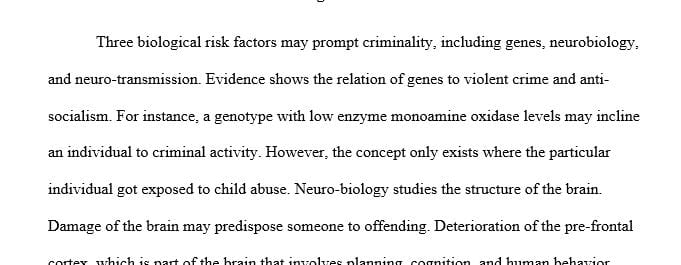
Discuss genetic or physiological evidence that supports the notion that biology played a key role in explaining the offender’s criminality

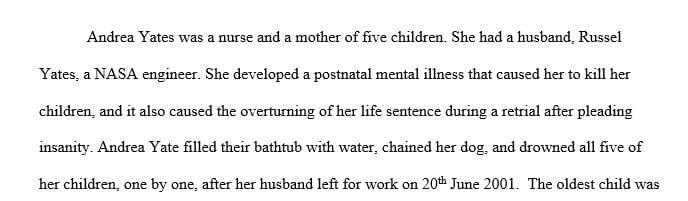
Andrea Yates and the documented evidence of psychiatric issues, including postpartum depression and psychosis, prior to murdering her five children.

Summarize the case.
Discuss the genetic or physiological evidence that supports the notion that biology played a key role in explaining the offender’s criminality.
Research the behaviors that constitute psychopathy and discuss in detail the specific behaviors demonstrated by the offender that align (or not) with behaviors indicative of a psychopathic individual.
Identify if the positivist perspective applies to your chosen example. Explain your answer.
Identify if the punishment rendered in your chosen example best supports the classical or neoclassical perspective of crime. Explain your answer.

Include at least 2 academic references and cite your sources according to APA guidelines.

Discuss the genetic or physiological evidence that supports the notion that biology played a key role in explaining the offender's criminality.

You must proofread your paper. But do not strictly rely on your computer’s spell-checker and grammar-checker; failure to do so indicates a lack of effort on your part and you can expect your grade to suffer accordingly. Papers with numerous misspelled words and grammatical mistakes will be penalized. Read over your paper – in silence and then aloud – before handing it in and make corrections as necessary. Often it is advantageous to have a friend proofread your paper for obvious errors. Handwritten corrections are preferable to uncorrected mistakes.

Use a standard 10 to 12 point (10 to 12 characters per inch) typeface. Smaller or compressed type and papers with small margins or single-spacing are hard to read. It is better to let your essay run over the recommended number of pages than to try to compress it into fewer pages.

Likewise, large type, large margins, large indentations, triple-spacing, increased leading (space between lines), increased kerning (space between letters), and any other such attempts at “padding” to increase the length of a paper are unacceptable, wasteful of trees, and will not fool your professor.

The paper must be neatly formatted, double-spaced with a one-inch margin on the top, bottom, and sides of each page. When submitting hard copy, be sure to use white paper and print out using dark ink. If it is hard to read your essay, it will also be hard to follow your argument.

Read More
Research Paper

Assignment: What do you think about the influence biology, psychology and physical environment on crime.

Respond to the following in a minimum of 175 words:

There are many perspectives on crime and its causation. What do you think about the influence biology, psychology, and physical environment on crime? What, if any, are other potential causes of crime?

Answer preview to What do you think about the influence biology, psychology and physical environment on crime

What do you think about the influence biology psychology and physical environment on crime

You must proofread your paper. But do not strictly rely on your computer’s spell-checker and grammar-checker; failure to do so indicates a lack of effort on your part and you can expect your grade to suffer accordingly. Papers with numerous misspelled words and grammatical mistakes will be penalized. Read over your paper – in silence and then aloud – before handing it in and make corrections as necessary. Often it is advantageous to have a friend proofread your paper for obvious errors. Handwritten corrections are preferable to uncorrected mistakes.

Use a standard 10 to 12 point (10 to 12 characters per inch) typeface. Smaller or compressed type and papers with small margins or single-spacing are hard to read. It is better to let your essay run over the recommended number of pages than to try to compress it into fewer pages.

Likewise, large type, large margins, large indentations, triple-spacing, increased leading (space between lines), increased kerning (space between letters), and any other such attempts at “padding” to increase the length of a paper are unacceptable, wasteful of trees, and will not fool your professor.

The paper must be neatly formatted, double-spaced with a one-inch margin on the top, bottom, and sides of each page. When submitting hard copy, be sure to use white paper and print out using dark ink. If it is hard to read your essay, it will also be hard to follow your argument.

ADDITIONAL INSTRUCTIONS FOR THE CLASS

Discussion Questions (DQ)

Initial responses to the DQ should address all components of the questions asked, include a minimum of one scholarly source, and be at least 250 words.
Successful responses are substantive (i.e., add something new to the discussion, engage others in the discussion, well-developed idea) and include at least one scholarly source.
One or two sentence responses, simple statements of agreement or “good post,” and responses that are off-topic will not count as substantive. Substantive responses should be at least 150 words.
I encourage you to incorporate the readings from the week (as applicable) into your responses.

Weekly Participation

Your initial responses to the mandatory DQ do not count toward participation and are graded separately.
In addition to the DQ responses, you must post at least one reply to peers (or me) on three separate days, for a total of three replies.
Participation posts do not require a scholarly source/citation (unless you cite someone else’s work).
Part of your weekly participation includes viewing the weekly announcement and attesting to watching it in the comments. These announcements are made to ensure you understand everything that is due during the week.

APA Format and Writing Quality

Familiarize yourself with APA format and practice using it correctly. It is used for most writing assignments for your degree. Visit the Writing Center in the Student Success Center, under the Resources tab in LoudCloud for APA paper templates, citation examples, tips, etc. Points will be deducted for poor use of APA format or absence of APA format (if required).
Cite all sources of information! When in doubt, cite the source. Paraphrasing also requires a citation.
I highly recommend using the APA Publication Manual, 6th edition.

Use of Direct Quotes

I discourage overutilization of direct quotes in DQs and assignments at the Masters’ level and deduct points accordingly.
As Masters’ level students, it is important that you be able to critically analyze and interpret information from journal articles and other resources. Simply restating someone else’s words does not demonstrate an understanding of the content or critical analysis of the content.
It is best to paraphrase content and cite your source.

LopesWrite Policy

For assignments that need to be submitted to LopesWrite, please be sure you have received your report and Similarity Index (SI) percentage BEFORE you do a “final submit” to me.
Once you have received your report, please review it. This report will show you grammatical, punctuation, and spelling errors that can easily be fixed. Take the extra few minutes to review instead of getting counted off for these mistakes.
Review your similarities. Did you forget to cite something? Did you not paraphrase well enough? Is your paper made up of someone else’s thoughts more than your own?
Visit the Writing Center in the Student Success Center, under the Resources tab in LoudCloud for tips on improving your paper and SI score.

Late Policy

The university’s policy on late assignments is 10% penalty PER DAY LATE. This also applies to late DQ replies.
Please communicate with me if you anticipate having to submit an assignment late. I am happy to be flexible, with advance notice. We may be able to work out an extension based on extenuating circumstances.
If you do not communicate with me before submitting an assignment late, the GCU late policy will be in effect.
I do not accept assignments that are two or more weeks late unless we have worked out an extension.
As per policy, no assignments are accepted after the last day of class. Any assignment submitted after midnight on the last day of class will not be accepted for grading.

Communication

Communication is so very important. There are multiple ways to communicate with me:
Questions to Instructor Forum: This is a great place to ask course content or assignment questions. If you have a question, there is a good chance one of your peers does as well. This is a public forum for the class.
Individual Forum: This is a private forum to ask me questions or send me messages. This will be checked at least once every 24 hours.

Read More
Research Paper

Discuss genetic or physiological evidence that supports the notion that biology played a key role in explaining the offender’s criminality.

Assignment Content

There are offenders whose criminality is based on biological factors. This may or may not be known to the offender prior to a deadly incident like the examples in this assignment. Biological anomalies are not common, but in many cases, the results are catastrophic. The cases outlined for this assignment are some of the most notorious. This assignment will help you develop a better understanding of mental illness and physiology as factors when measuring criminality.

Choose a criminal offender from the list below, or one of your choosing, whose criminal behavior was connected to a biological abnormality (physical, psychological, or chemical):

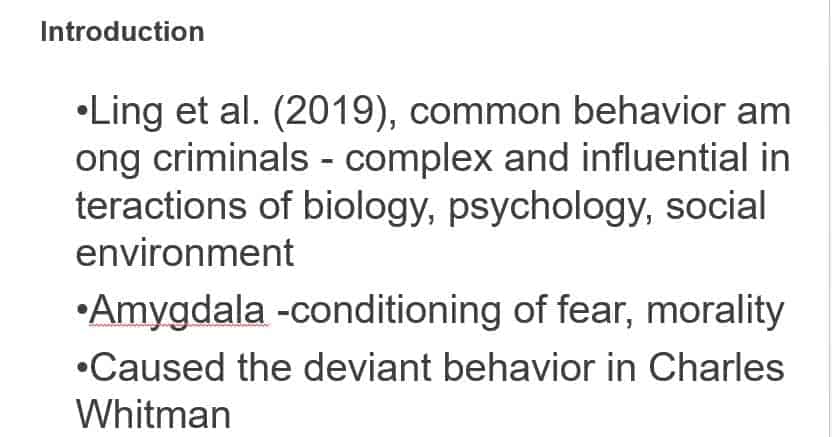
Andrea Yates and the documented evidence of psychiatric issues, including postpartum depression and psychosis, prior to murdering her five children. Jeffrey Dahmer and the documented evidence of psychiatric issues prior to murdering 17 men. John Wayne Gacy and the documented evidence of psychiatric issues prior to murdering 33 young men and boys. Charles Whitman murdered 16 people, including his wife and mother. An autopsy suggested Whitman had a brain tumor pressing on his amygdala, a region of the brain crucial for emotion and behavioral control.

Create an 8- to 10-slide Microsoft® PowerPoint® presentation with speaker notes in which you:

Summarize the case. Discuss the genetic or physiological evidence that supports the notion that biology played a key role in explaining the offender’s criminality. Research the behaviors that constitute psychopathy and discuss in detail the specific behaviors demonstrated by the offender that align (or not) with behaviors indicative of a psychopathic individual. Identify if the positivist perspective applies to your chosen example. Explain your answer. Identify if the punishment rendered in your chosen example best supports the classical or neoclassical perspective of crime. Explain your answer.
Include at least 2 academic references and cite your sources according to APA guidelines
Make sure each slide has at least 150 words

Discuss the genetic or physiological evidence that supports the notion that biology played a key role in explaining the offender's criminality.

You must proofread your paper. But do not strictly rely on your computer’s spell-checker and grammar-checker; failure to do so indicates a lack of effort on your part and you can expect your grade to suffer accordingly. Papers with numerous misspelled words and grammatical mistakes will be penalized. Read over your paper – in silence and then aloud – before handing it in and make corrections as necessary. Often it is advantageous to have a friend proofread your paper for obvious errors. Handwritten corrections are preferable to uncorrected mistakes.

Use a standard 10 to 12 point (10 to 12 characters per inch) typeface. Smaller or compressed type and papers with small margins or single-spacing are hard to read. It is better to let your essay run over the recommended number of pages than to try to compress it into fewer pages.

Likewise, large type, large margins, large indentations, triple-spacing, increased leading (space between lines), increased kerning (space between letters), and any other such attempts at “padding” to increase the length of a paper are unacceptable, wasteful of trees, and will not fool your professor.

The paper must be neatly formatted, double-spaced with a one-inch margin on the top, bottom, and sides of each page. When submitting hard copy, be sure to use white paper and print out using dark ink. If it is hard to read your essay, it will also be hard to follow your argument.

ADDITIONAL INSTRUCTIONS FOR THE CLASS

Discussion Questions (DQ)

Initial responses to the DQ should address all components of the questions asked, include a minimum of one scholarly source, and be at least 250 words.
Successful responses are substantive (i.e., add something new to the discussion, engage others in the discussion, well-developed idea) and include at least one scholarly source.
One or two sentence responses, simple statements of agreement or “good post,” and responses that are off-topic will not count as substantive. Substantive responses should be at least 150 words.
I encourage you to incorporate the readings from the week (as applicable) into your responses.

Weekly Participation

Your initial responses to the mandatory DQ do not count toward participation and are graded separately.
In addition to the DQ responses, you must post at least one reply to peers (or me) on three separate days, for a total of three replies.
Participation posts do not require a scholarly source/citation (unless you cite someone else’s work).
Part of your weekly participation includes viewing the weekly announcement and attesting to watching it in the comments. These announcements are made to ensure you understand everything that is due during the week.

APA Format and Writing Quality

Familiarize yourself with APA format and practice using it correctly. It is used for most writing assignments for your degree. Visit the Writing Center in the Student Success Center, under the Resources tab in LoudCloud for APA paper templates, citation examples, tips, etc. Points will be deducted for poor use of APA format or absence of APA format (if required).
Cite all sources of information! When in doubt, cite the source. Paraphrasing also requires a citation.
I highly recommend using the APA Publication Manual, 6th edition.

Use of Direct Quotes

I discourage overutilization of direct quotes in DQs and assignments at the Masters’ level and deduct points accordingly.
As Masters’ level students, it is important that you be able to critically analyze and interpret information from journal articles and other resources. Simply restating someone else’s words does not demonstrate an understanding of the content or critical analysis of the content.
It is best to paraphrase content and cite your source.

LopesWrite Policy

For assignments that need to be submitted to LopesWrite, please be sure you have received your report and Similarity Index (SI) percentage BEFORE you do a “final submit” to me.
Once you have received your report, please review it. This report will show you grammatical, punctuation, and spelling errors that can easily be fixed. Take the extra few minutes to review instead of getting counted off for these mistakes.
Review your similarities. Did you forget to cite something? Did you not paraphrase well enough? Is your paper made up of someone else’s thoughts more than your own?
Visit the Writing Center in the Student Success Center, under the Resources tab in LoudCloud for tips on improving your paper and SI score.

Late Policy

The university’s policy on late assignments is 10% penalty PER DAY LATE. This also applies to late DQ replies.
Please communicate with me if you anticipate having to submit an assignment late. I am happy to be flexible, with advance notice. We may be able to work out an extension based on extenuating circumstances.
If you do not communicate with me before submitting an assignment late, the GCU late policy will be in effect.
I do not accept assignments that are two or more weeks late unless we have worked out an extension.
As per policy, no assignments are accepted after the last day of class. Any assignment submitted after midnight on the last day of class will not be accepted for grading.

Communication

Communication is so very important. There are multiple ways to communicate with me:
Questions to Instructor Forum: This is a great place to ask course content or assignment questions. If you have a question, there is a good chance one of your peers does as well. This is a public forum for the class.
Individual Forum: This is a private forum to ask me questions or send me messages. This will be checked

Read More