

In Discussion Forum 1, post your response to the following discussion questions. Reply to at least two classmates’ responses by the date indicated in the Course Calendar.
- Consider a plane that flies due east on a trip, and then returns due west following the same exact route. Imagine also that there are no winds in each trip. Flying due east, the plane flies with the rotation of the Earth, while flying due west, it flies against the rotation. Will the flight times be the same? Different? Why?
- The velocity of an object falling in free fall increases with time. Does the acceleration also increase? Why or why not?
- Why is that a cat that accidentally falls from a 50-story building hits a safety net below with the same speed as if it fell from a 20-story building?
- What is the acceleration at the top of a jump?
Written Assignment 2
Answer all of the following questions. Do not send in a partially completed assignment. Answer each question as completely as possible, but do not merely copy answers from your reading materials. If you cite a reference in the text, explain the meaning of the citation.
- Answer the following:
- What are the units of mass and the units of weight for the metric system?
- What are the units of mass and the units of weight for the English system?
- Explain the relationship between the mass and the weight of an object. Is the mass of an object the same on earth and the moon? Are the weights the same on earth and the moon?
- In your own words, explain Newton’s second law of motion and give two examples.
- How does mass affect the rate of acceleration in free fall:
- In air?
- In a vacuum?
- If the mass of a sliding block is tripled while a constant net force is applied, by how much does the acceleration decrease?
- Explain the difference between a vector and a scalar quantity. Give at least two examples of different variables that are vector and scalar quantities.
- Give an example of Newton’s third law of motion and explain why it is an example.
- For each of the following interactions, identify the action and reaction forces:
- A hammer hits a nail.
- Earth’s gravity pulls down on a book.
- A helicopter blade pushes air downward.
- Answer the following questions:
- If you stand next to a wall on a frictionless skateboard and push the wall with a force of 30 Newtons, how hard does the wall push on you?
- If your mass is 60 kilograms, what is your acceleration?
Lab Exercise 2: Acceleration
- Follow the instructions and directions below for this lab. Disregard the outline in the manual for your LabPaq Kit.
- Read this document entirely before starting your work.
- Do not forget to record your measurements and partial results.
- Submit a Laboratory Report through Moodle, as shown in the last section of this outline. Remember that the Laboratory Report should include the answers to the questions below.
GOAL
To calculate the acceleration of an object rolling down an inclined plane.
INTRODUCTION
Acceleration is the change in the velocity of an object. Velocity is a vector quantity with both direction and magnitude. Acceleration is also a vector quantity with both direction and magnitude. If the speed of an object is changed, that object has accelerated either positively or negatively depending on whether it increased or decreased in speed. Another way to accelerate an object is to change its direction of movement. This means that a car going around a corner is undergoing acceleration because its velocity in terms of direction is changing even if the car’s speed, as seen on the speedometer, is constant.
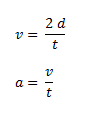
As discussed above, an object falling under the influence of gravity accelerates. From your studies, you can recall the key kinematic equations for the uniformly accelerated motion of an object starting from rest, where v = velocity, a = acceleration, and d = distance.

Using these equations it is then possible to solve for the unknown variables.
In this lab experiment, we will measure the time it takes for a marble to roll down an inclined plane. From the experimental data, we will then estimate the value of gravity (g).
PROCEDURE
Set up a ramp as shown in Figure 1 that will be our inclined plane. Depending on the distance of your ramp, mark intervals of 40 to 60 cm. For example, in Figure 1, the marks are at 50 cm. Ideally, the marks should be as separated as possible in order to obtain a better reading. The height of the ramp is also going to play a role in the accuracy of your measurements. The steeper the slope is, the ball will run down faster and will make measurements less accurate. Before starting with the measurements, you may want to run some trials in different conditions.


Figure 2: Experimental setup
Figure 2 shows the setup used by a student who did this lab some time ago. In this case, the marks are spaced 40 cm. This experiment works best with gentle angles of elevation. You may get better result if you use a smaller slope than Figure 2 shows. The recommended angles should be around 5 degrees, 10 degrees, and 15 degrees. You also need to record the angle of the inclined plane making a plumb line with the protractor as shown in Figure 3. The angle of elevation from this protractor is around 120.

Figure 3: Measuring the angle of an inclined plane
Measuring Time
Our procedure will consist of dropping the marble at the top of the inclined plane and measuring with the stopwatch the time it takes to reach each one of the markings, starting with the closest to the point where you release the marble. Using the example shown in Figure 1, we will first measure the time it takes for the ball to go from 0 cm to 50 cm. As we learned in Laboratory Experiment #1, it is always good practice to repeat the measurements several times (in our case 5 times) to reduce errors.
When we have taken and recorded the 5 trials for this first measurement, we will proceed by repeating the experiment but in this case measuring the time that it takes for the ball to reach the second mark (in the example of Figure 1, it will be from 0 to 100 cm).
Equations used for this experiment
The known variable in this experiment is the distance between the marks. The measured variable in this experiment is the time it takes for the ball to travel a specified distance.
For a body undergoing accelerated movement, the equations that we will use are:
INITIAL PARAMETERS
| QUESTION 1: What is the distance between two marks in your inclined plane? |
| QUESTION 2: What is the angle of your inclined plane with respect the horizontal? (0° would mean the inclined plane totally horizontal, so the ball would not move; 90° would mean the board totally vertical) |
Write down these two values in the table we will use to record all our measurements. It will also be used at the end of the lab.

0 comments