

In this module and the next, we will look closely at the two overarching categories of research design (referred to as research models in your text): experimental and nonexperimental. Both the experimental and nonexperimental designs encompass various types of research methods. This module will focus on experimental research design and the two methods encompassed within it.
Variables
Let’s review some important concepts: independent, dependent and confound variables.
- Independent variable – what is being manipulated by the researcher in the study.
- Dependent variable – is affected by changes in the independent variable. It’s what is being measured in the study.
- Confound variable – uncontrolled extraneous variables (or flaws in the experiment) that may also influence the dependent variable.
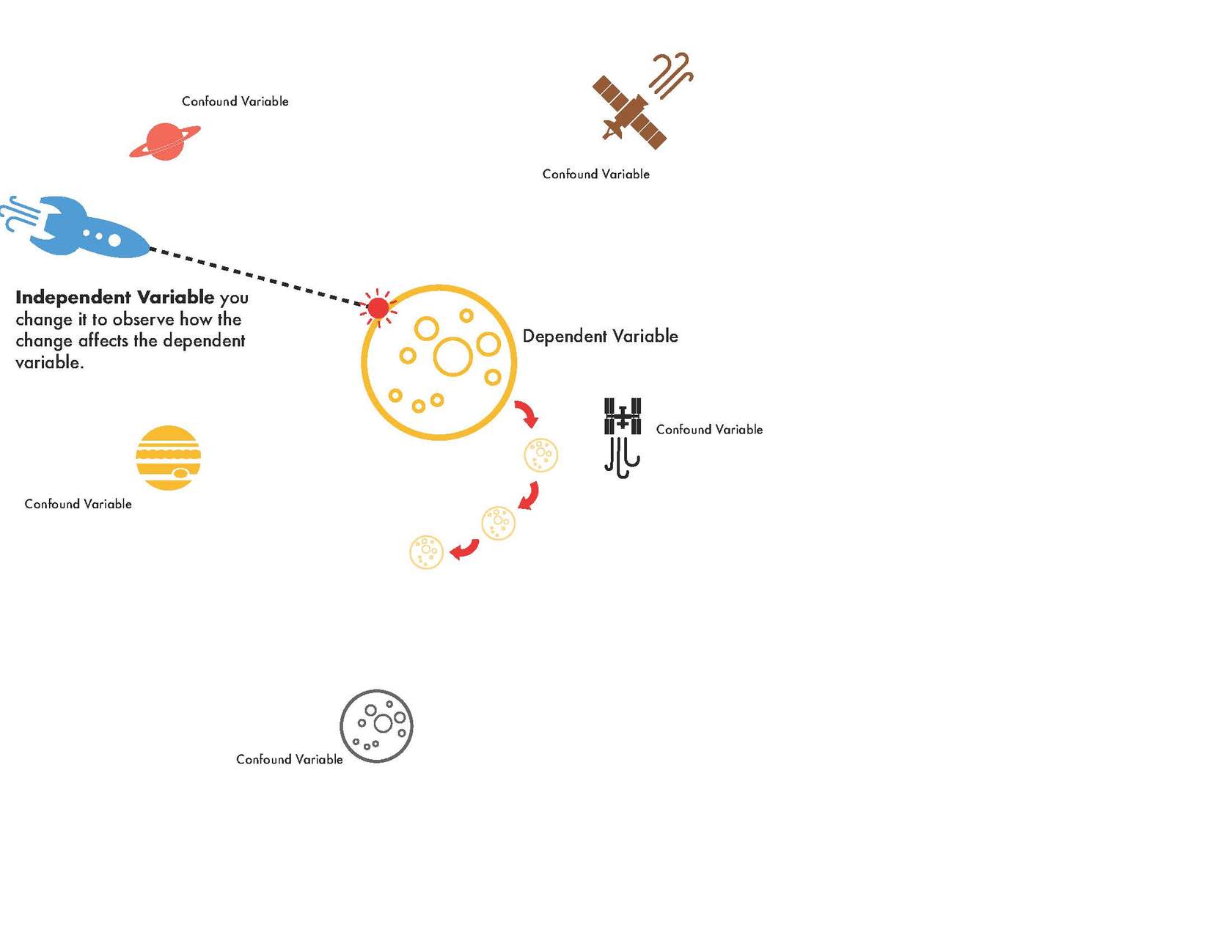
Think about variables as if it were a video game where a meteor hurtles toward the earth. You’re tasked with changing the trajectory to save the planet.
The position of your spaceship when you fire upon the meteor is the independent variable. The trajectory of the meteor is the dependent variable.
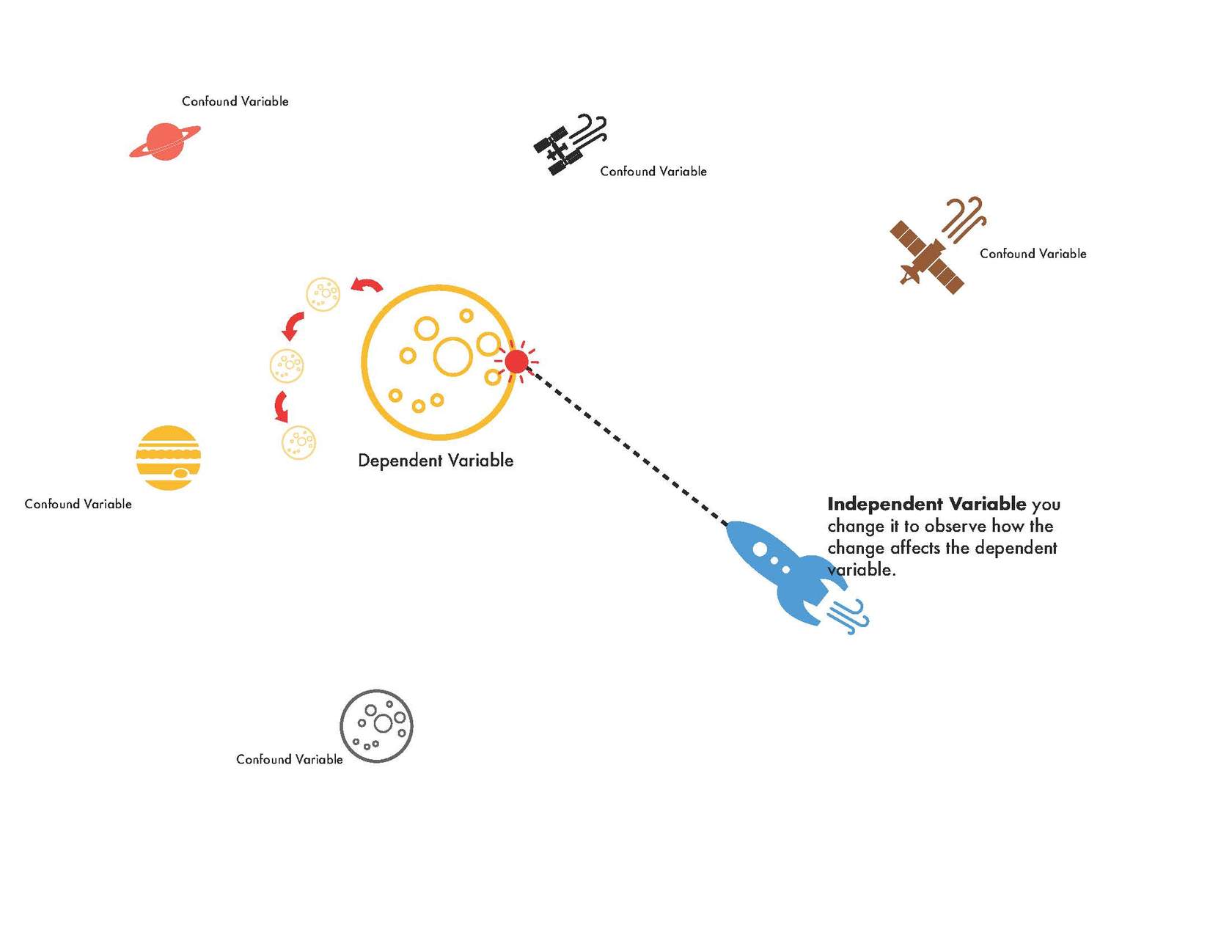
Changing your position affects the dependent variable.
Confound variables are uncontrolled extraneous variables (like a satellite, another meteor, gravitational pull from a planet) that may also affect the dependent variable.
Research Methods
The experimental research model encompasses two types of research methods: experimental and quasi-experimental, which enable a researcher to establish a cause-effect relationship through the manipulation of a variable and control of the situation, ultimately supported by statistical analysis.
Experiments are common and useful tools for researchers in many fields because they enable us to make causal conclusions. Another way to think of experimental research is…
…does a change in the independent variable cause a change in the dependent variable?
Remember the spaceship/meteor analogy? It’s also an informal experiment. The pilot experiments with the position of the spaceship to observe its effect on the change in the trajectory of the meteor.
There are three key features that distinguish an experimental from a nonexperimental method.
- 1The independent variable is systematically manipulated by the researcher (e.g., one group of participants is given a new diabetes drug and the other group is given a placebo).
- 2Random assignment of participants. This means that all participants have an equal chance of being placed in either the treatment or the control group (i.e., participants in the diabetes drug study have equal chance of being placed in the group that receives the new drug [treatment group] or the placebo [control group].
- 3The researcher minimizes the variability in the two different conditions through control. Taking our diabetes drug study as an example the researcher would likely make sure that all participants have the same type of diabetes that the drug is intended to help with; individuals in the treatment group are receiving the same dosage (i.e., amount of the drug); participants take the medication at the same time each day; etc.
Controls
Why is control important in an experiment?
Control is important in an experimental study because researchers want to be able to say that X caused Y. This means that researchers must control for extraneous variables; in other words, anything that might make it difficult to determine whether the independent variable had an effect on the dependent variable.
Time: 4:18 mins
Closed captioned

Controlled Experiments: Causal Inference Bootcamp
This module introduces controlled experiments for learning about causal effects and explains why they usually aren’t possible in social science.
How can extraneous variables be controlled for?
Extraneous variables can be held constant. This means controlling the situation so that all participants, regardless of being placed in the treatment or control group, will receive the new diabetes drug or placebo in the same location; they will receive the same instructions; they will be treated the same way, etc.
Another way to control for extraneous variables is to limit eligibility of participants in the study to very specific characteristics.
For example, only individuals with type two diabetes, ranging in age from 20-25, could participate in the study. However, controlling in this way limits the researcher’s ability to generalize their findings to a larger population. In this case, the researcher could conclude (based on the data!) only that the drug either works or does not work at effectively managing type two diabetes in individuals ranging in age from 20-25.
Some famous experiments:
BOBO DOLL EXPERIMENTDOMESTIC VIOLENCE EXPERIMENT
Dr. Albert Bandura’s Bobo Doll Experiment: The purpose of this experiment was to prove that human behavior is largely based on social imitation rather than inherited genetic factors.
What are the independent and dependent variables? How did he manipulate the independent variable? What about controls?
Lesson 2 – Experimental and Quasi-ExperimentalQuasi-experimental research is a combination of the nonexperimental and experimental research methods. It allows for the comparison of naturally occurring groups (i.e., you may not have a control or comparison group).
Using the quasi-experimental method, researchers can measure the independent variable and examine its impact on the dependent variable, but researchers are unable to control other factors or have only limited control, which makes it difficult to rule out alternative explanations.
The key difference between quasi-experimental and experimental research methods has to do with the random assignment of participants to a condition. Quasi-experiments do not randomly assign participants.
The Tuskegee Experiment was actually a quasi-experiment because the participants were grouped based on whether or not they had syphilis at the start of the study.
Quasi-experiments are most appropriate when random assignment of participants is difficult or impossible.
Types of Quasi-Experimental Designs
Single-Group Posttest-Only Design
–
This is a very simple design in which all participants are in one group that receives the independent variable (IV) manipulation. You cannot draw any conclusions about relationships between the variables when using this design because you have no control or comparison group.
An example of a single-group posttest-only design would be examining a group of students who attend an after school program for homework help and measuring their attitudes toward homework after participating in the program.
Non-Equivalent Groups Posttest-Only Design
–
Using this design, you compare two different groups of participants who have been exposed to different IV conditions. Although you have two groups of participants, it is important to note that they were not randomly assigned, but rather were pre-existing groups.
Using the previous example where we have one group of students who attend an after school program for homework help and measure their attitudes toward homework after participating in the program. For the non-equivalent groups posttest-only design, we would have a second group of students who does not participate in the after school program for homework help, and we measure their attitudes toward homework.
Single-Group Pretest-Posttest Design
+
Non-equivalent Pretest-Posttest Design
–
Data is collected from two groups of participants; however, participants are not randomly assigned to the groups which means we cannot say that the two groups are equivalent.
Since this is a pretest-posttest design, we can compare between the groups on their pretest and posttest measures, and we can compare within the groups (e.g., comparing differences in pretest and posttest scores for just one of the participant groups). If any changes are observed, there is no way to be certain whether they were due to manipulation of the IV or confounds.
For this example, we would have two groups of students. The researcher would conduct the pretest for both groups, measuring attitudes toward homework. Then one group would participate in the after school homework program, and the other would not. After the one group participates in the after school program, the researcher would administer the posttest to measure their attitudes toward homework.
Multiple-Groups Time-Series Design

0 comments