

Use this activity to assess whether you and your peers can:
- Use StatCrunch to conduct a hypothesis test to test a claim about a population mean.
- State an appropriate conclusion in context.
- Explain the meaning of each relevant item from the StatCrunch output.
Context
A group of 75 college students from a liberal arts college were randomly sampled and asked about the number of alcoholic drinks they have in a typical week. The file containing the data is linked below. The purpose of this study (Links to an external site.) was to compare the drinking habits of the students at the college to the drinking habits of college students in general. In particular, the dean of students, who initiated this study, would like to check whether the mean number of alcoholic drinks that students at his college have in a typical week differs from the mean of U.S. college students in general, which is estimated to be 4.73.
Variables
The number of alcoholic beverages a student consumes in a week.
Data
Open the drinks datafile in the Stats at Cuyamaca College group on StatCrunch (directions – opens in a new tab).
Note – the drinks datafile is different from the college_drinking file.
Prompt
The drinks datafile is available in the Data section above.
- Let
- Here is a histogram of the data. Can we safely use the t-test with this data? Explain.
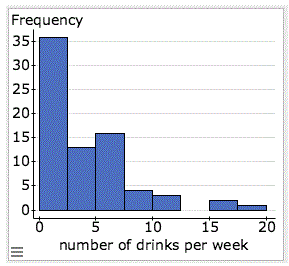
- Perform the t-test using StatCrunch. (directions)
Copy and paste the information from the StatCrunch output window into the textbox. - Based on the P-value, state your conclusions in context. Use a 5% level of significance.
NOTE: You do not need to double the P-value for this two-tailed test. StatCrunch calculates the P-value for you. - Using the context of this scenario, explain the meaning of each of following items from the StatCrunch output for the hypothesis test.
- Std. Err (standard error)
- T-stat (T-score)
- P-value

0 comments